BESS+: A Bio-Electronic Soil Sentinel Network for Climate Monitoring and Flood Risk Prediction.
Hi there.
I sent an idea to ESA (European Space Agency) in order to attend a need, I called this project BESS+: A Bio-Electronic Soil Sentinel Network for Climate Monitoring and Flood Risk Prediction.
the Abstract is below:
BESS+ (Bio-Electronic Soil Sentinel) is a low-cost, energy-efficient sensing network designed to monitor soil health and predict environmental risks such as flooding in real time. The system integrates miniature bioelectronic sensors with satellite-connected ground units to collect key soil data, such as moisture, pH, gas emissions (CO₂, CH₄), and temperature, across large and remote areas with minimal infrastructure.
What makes BESS+ unique is its mesh-based communication design: compact sensor nodes distributed throughout the field communicate with each other, and only one master node transmits the aggregated data via satellite. Each node is powered by a long-life rechargeable battery, designed to operate autonomously for at least one year in the field without maintenance. GPS modules on each unit ensure precise geo-tagging of all measurements.
By delivering high-resolution, ground-truth data with minimal energy use and no dependence on cellular networks, BESS+ helps close the gap between space-based Earth observation and on-the-ground soil dynamics. It directly supports sustainable land management, climate adaptation, and disaster preparedness by enabling early detection of soil degradation and flooding risks, empowering farmers, and civil authorities interested on this topic.
I will let you know about the progress of this amazing idea.

Gracias a los mas de 140.000 visitantes al blog
Ahora con un promedio de 3000 visitantes por mes actualmente, hace poco el blog superó los 280.000 visitantes desde su creación en 2009 cuando un día de junio empezó este hobby, recibiendo visitas de todas partes del mundo.
Mil gracias a todos los lectores, espero ser mas juicioso con sus correos, a continuación una imagen del ultimo año que muestra visitantes de todos los continentes.

Un abrazo fraternal.
Mil gracias a todos los lectores, espero ser mas juicioso con sus correos, a continuación una imagen del ultimo año que muestra visitantes de todos los continentes.
Un abrazo fraternal.
A performance evaluation of three inference engines as expert systems for failure mode identification in shafts
A performance evaluation of three inference engines as expert systems for failure mode identification in shafts, download paper at
https://docs.google.com/viewer?a=v&pid=sites&srcid=ZGVmYXVsdGRvbWFpbnxhcmNoaXZvc2Jsb2djam1nfGd4OjRlOTE0YTA3MzgyYTllNzE
https://docs.google.com/viewer?a=v&pid=sites&srcid=ZGVmYXVsdGRvbWFpbnxhcmNoaXZvc2Jsb2djam1nfGd4OjRlOTE0YTA3MzgyYTllNzE
Articles | 16 Question Survey | ReliabilityWeb.com: A Culture of Reliability
Articles | 16 Question Survey | ReliabilityWeb.com: A Culture of Reliability
What amazing article, just 16 questions that in deeply manner could change everything in your organization, and is interesting for us because in a little part is related to the Campbell's maintenance excellence matrix in order to improve our reliability and maintenance programs.
Little changes could result in big improvements, starting in the study of little defects... interesting, very interesting is the evidence of world class organizations.
Best regards.
What amazing article, just 16 questions that in deeply manner could change everything in your organization, and is interesting for us because in a little part is related to the Campbell's maintenance excellence matrix in order to improve our reliability and maintenance programs.
Little changes could result in big improvements, starting in the study of little defects... interesting, very interesting is the evidence of world class organizations.
Best regards.
¿Do you want to become an IEEE autor?
I found this funny picture at the web...sometimes true, so I prefer Science direct or springer link for the same purpose...enjoy!!!

Increasing Accuracy in Lubrication Testing
Articles | Increasing Accuracy in Lubrication Testing | ReliabilityWeb.com: A Culture of Reliability
Tips for tribology improvement programs.
Enjoy.
Best regards.
Tips for tribology improvement programs.
Enjoy.
Best regards.
Experts systems and artificial intelligence applied to interpretation and diagnosis in complex mechatronics systems
Hi everybody, as you know I am Electronics engineer with a strong background in control systems, instrumentation and industrial automation and also I am finishing my masters degree in mechanical engineering, you know I love the mechatronics engineering and their role in the actual technical world,
today I want to show you some of the results that I found in my masters thesis project called, "Design, implementation and evaluation of a expert systems applied for failure analysis in mechanical elements" (Axis, gears, bearings and boilers), in that thesis project I´m comparing three different inference engines as a artificial intelligence strategy for diagnosis and interpretation:
The finish document is here http://www.bdigital.unal.edu.co/45143/
And here there is a paper (you can download for free the pdf for the next 50 days) about this work published in the engineering failure analysis journal Science direct.
http://www.sciencedirect.com/science/article/pii/S1350630715001089
The finish document is here http://www.bdigital.unal.edu.co/45143/
And here there is a paper (you can download for free the pdf for the next 50 days) about this work published in the engineering failure analysis journal Science direct.
http://www.sciencedirect.com/science/article/pii/S1350630715001089
1. Clasic inference engine: based in modus tollens and modus ponens rules.
2. Fuzzy inference engine: Based on a previous comparation between sugeno and mamdani inference engines.
3. Bayesian inference engine, based on bayesian networks.
The system that I developed for axis has got 4 modules:Fracture, corrosion, wear and plastic modules.
Acordding to the different test that I did, I am very surprised because the bayesian inference engine have been the better behavior compares with the clasic and fuzzy inference engine, is amazing how the system solves complex cases of interpretation of evidence in many failure analysis process, Im using a lot of failure analysis cases from the National University of Colombia (AFIS group have been resolved cases for many industries like Oil & gas, automotive and complex heavy industries).
At the end of my thesis ,probably 2 months, :)I will post the final results, this research project also could be implemented in other engineering fileds (instrumentation, automation and control systems) with amazing results.
I think that in the near future the applied cibernetics as artificial intelligence will be the win ticket for many companies thart spend a lot of money and time designing experts systems for their engineering optimization, honestly I think that artificial intelligence is the future for those industries.
Do you want to see a print screen of my system?
1. An example of bayesian network just for fracture module in axis:

2. Take a look around of the wear module, few questions are necesary to identify the failure mode, based in the knowledge base:

3. After of the analysis according to the evidence for example for adhesive failure wear mode the system shows the following fault three analysis FTA.(for more information of FTA analsysis read the certified realiability engineer handbook)

The GUI was developed using Matlab/Simulink GUIDE (Bayesian and fuzzy) and C#+Amzi! Prolog (clasic inference). The work has been hard.
The most interesting result in this research masters project is the integration of a lot of my passions in one project as Electronics engineering, mechanical engineering, software develop and control systems, maintenance and reliability knowledge...
Some Oil & Gas companies are interested to implement this system in those industries for interpretation and diagnosis in their specific process (alarm management, Safety Instrumentation systems, control systems), I will be waiting for new challenges :)
15.000 visitors...unbelievable!!!
I can't belive it, i'm glad and I appreciate it... more of 15.000 visitors since the blog was opened, when I was writing the first messages, I never thought that one day the number of readers will be greater than probably 1000 or 2000 visitors... is amazing how the web open the world at your desk.
Best regards.
Fuzzy adaptative PID controller test
I want to show you this paper that I made, using the original paper “Temperature Control System Based on Fuzzy Self-Adaptive PID Controller” by Xin H. et al ,presented in the Third International Conference on Genetic and Evolutionary Computing (2009).
During the test and review process I found an error because the authors in the original paper dont used the error input in the adaptative fuzzy PID parameters so... how they can show the result without this error input ? I wrote to the authors telling them this error but I have not received any answer.
Enjoy the document is interesting, the document is in spanish...
Mechatronics and the Role of Engineers - ASME
Mechatronics and the Role of Engineers - ASME
An interesting review about the most wonderful and great ocupation for me around the world, the mechatronics engineering.
The mechatronics engineering acording to my personal point of view, is just the exotic juice of differents fields of knowledge, I am glad to be part of that. Best regards Carlos Javier Moreno Gomez
An interesting review about the most wonderful and great ocupation for me around the world, the mechatronics engineering.
The mechatronics engineering acording to my personal point of view, is just the exotic juice of differents fields of knowledge, I am glad to be part of that. Best regards Carlos Javier Moreno Gomez
Failure is not an option
During my last training and research in failure analysis and reliability engineering program, I found a material from Case Western Reserve University (Mechanical and aerospace department),in this case is a failure analysis podcast... the podcast has got the following description:
"Methods and procedures for determining the basic causes of failures in structures and components. Recognition of fractures and excessive deformations in terms of their nature and origin. Development and full characterization of fractures. Legal ethical, and professional aspects of failures from service."
 I think that is an interesting material, due you could to learn any where with this podcast, so I want to give you the link for this interesting podcast.
http://itunes.apple.com/us/itunes-u/emse-511-failure-analysis/id386066906
The picture is just for fun, when I was in Space Center Houston I read a shirt with the message, always I remember it...
Enjoy the podcast.
Rgds.
"Methods and procedures for determining the basic causes of failures in structures and components. Recognition of fractures and excessive deformations in terms of their nature and origin. Development and full characterization of fractures. Legal ethical, and professional aspects of failures from service."
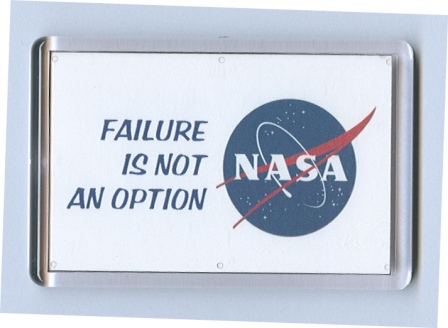
http://itunes.apple.com/us/itunes-u/emse-511-failure-analysis/id386066906
The picture is just for fun, when I was in Space Center Houston I read a shirt with the message, always I remember it...
Enjoy the podcast.
Rgds.
Tutorials | How To...Create a Pareto Chart in Excel | ReliabilityWeb.com: A Culture of Reliability
Tutorials How To...Create a Pareto Chart in Excel ReliabilityWeb.com: A Culture of Reliability
Good tutorial for Pareto Diagrams, wonderful tool in maintenance analysis.
Good tutorial for Pareto Diagrams, wonderful tool in maintenance analysis.
A little project for failure analysis in Mechanical Elements using Catia
Hi, right now I'm working with a wonderful software called Catia, is a powerful tool for mechanic and metchatronics design developed by Dassault Systémes in France.
I made this little example using Catia, the next step is to make a Finite Element Analisys (FEA) using Catia.

I wonder... is possible to simulate a craking propagation using FEA for Failure Analysis in a boiler or some mechanical element using Catia? I'll to work on that goal...
For more information about Catia visit www.catia.ru
See you...
I made this little example using Catia, the next step is to make a Finite Element Analisys (FEA) using Catia.

I wonder... is possible to simulate a craking propagation using FEA for Failure Analysis in a boiler or some mechanical element using Catia? I'll to work on that goal...
For more information about Catia visit www.catia.ru
See you...
The certified reliability engineer handbook
Today I will recommend you the following book The Certified Reliability Engineer Handbook.
 Reliability engineers are professionals who understand the principles of performance evaluation and prediction to improve product/systems safety, reliability, and maintainability. This handbook’s chapters and sections match the Body of Knowledge (BOK) specified for ASQ’s Reliability Engineer certification, which includes design review and control; prediction, estimation, and apportionment methodology; failure mode effects and analysis; the planning, operation, and analysis of reliability testing and field failures, including mathematical modeling; understanding human factors in reliability; and the ability to develop and administer reliability information systems for failure analysis, design and performance improvement, and reliability program management over the entire product life cycle.
http://www.asq.org/quality-press/display-item/index.html?item=H1304
Right now I'm reading this book and I think is a good choise whom loves the maintenance and reliability engineering.
 Reliability engineers are professionals who understand the principles of performance evaluation and prediction to improve product/systems safety, reliability, and maintainability. This handbook’s chapters and sections match the Body of Knowledge (BOK) specified for ASQ’s Reliability Engineer certification, which includes design review and control; prediction, estimation, and apportionment methodology; failure mode effects and analysis; the planning, operation, and analysis of reliability testing and field failures, including mathematical modeling; understanding human factors in reliability; and the ability to develop and administer reliability information systems for failure analysis, design and performance improvement, and reliability program management over the entire product life cycle.
http://www.asq.org/quality-press/display-item/index.html?item=H1304
Right now I'm reading this book and I think is a good choise whom loves the maintenance and reliability engineering.
Labview - Stepping Motors and Labview
I made a little application in Labview for stepping motors, I used the local variables for the shift registers.

The application was made in spanish and using labview 8.6.
link: Go to application
Enjoy, See you...
The application was made in spanish and using labview 8.6.
link: Go to application
Enjoy, See you...
VFD Micromaster 430 Siemens
Hi this is a litlle material about VFD (Siemens micromaster 430 series). Its very interesting because in the real world the parameter procces is the same of the simulator I wordked with the micromaster 440 in some industrial applications.
In this site you can be able to configure and explore the principal functions of the VFD.
 GO : AC Drives Siemens
Inscription à :
Articles (Atom)